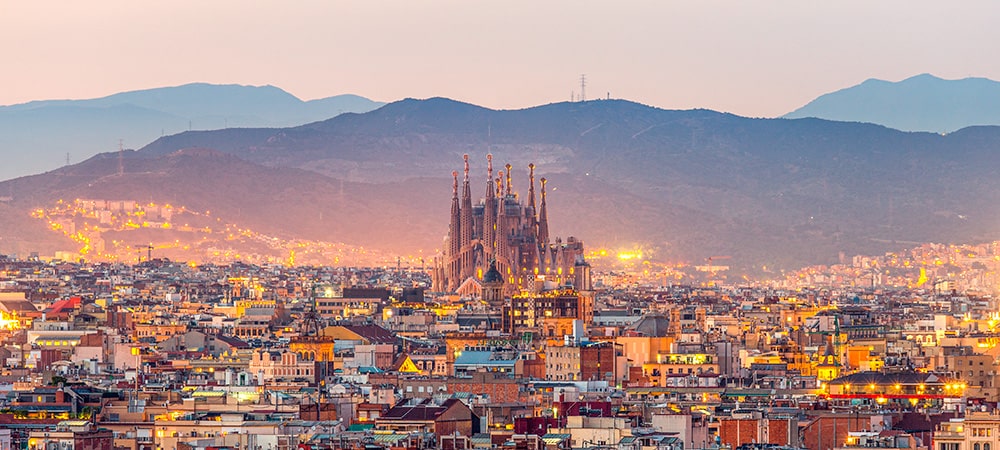
The Best Barcelona Modernisme Route on the city
The Barcelona Modernisme Route is an itinerary that takes you through the Barcelona of Gaudí, Domènech i Montaner and Puig i Cadafalch, the architects who, together with others, made Barcelona the world capital of Modernisme. This Route enables you to get to know thoroughly impressive palatial residences, amazing houses, the temple that has become a symbol of the city and a huge hospital, but it also includes humbler and more everyday buildings and items such as chemists’, shops, lampposts and benches – 115 works in all which show that Art Nouveau put down strong roots in Barcelona and today Modernisme is still an art that is alive and part of life in the city.
Discover Modernista Barcelona. You will see some of the most beautiful and unusual Modernista buildings in Barcelona. In addition to some of the famous buildings by Antoni Gaudí you will see other some of the other master pieces by other architects from the same periods.
As an introduction to Modernisme in Barcelona, or for those who only have a few hours to spare, the Modernismee Route recommends the Barcelona Walking Tours organised by Hidden Barcelona that start from the Information on this email: info@hiddenbarcelona.com.
- Pricing 160€ 4 hours, guide visit by oficia ras per visita guiada.
- Groups Maximun 10 people.
- Tickets non included on the price.
- Time table from 9am to 8 pm
- More info send an email to info@hiddenbarcelona.com
- Language English and Spanish
Barcelona Modernisme Route details:
Casa Fuster
Domènech i Montaner’s last work in Barcelona (1908-1911). This building marks the end of Passeig de Gràcia and to some extent summarises the work of Lluís Domènech i Montaner. The façade has a cylindrical tower typical of the architect, adorned with sculptures that simulate swallows’ nests, and a curious French-style attic which is not very common in Modernista architecture. The building should have been crowned with a tower similar to that of the administration pavilion of the Hospital de Sant Pau, but it was never completed.
For many years, the mythical Cafè Vienès wich occupied the ground floor, together with the dance hall El Danubio in the basement, was one of the main meeting points of the city. In 2004 the company Hoteles Center reopened the Cafè Vienès, after buying the house and fully restoring it into a luxury hotel (for further information see Let’s Go Out, the guide to Modernista bars and restaurants).
Casa Comalat
By Salvador Valeri i Popurull. This unusual and spectacular work (1909-1911), which is highly influenced by Gaudí, is also particularly interesting for its two façades: the main façade, which is symmetrical and urban, and the rear façade (on Carrer Còrsega), which is less formal, polychrome and decorated with peculiar Modernista wooden galleries with blinds and coloured ceramic work. The interior is no less impressive, with mosaic paving and exquisite furniture featuring unusually shaped benches and the peculiar foyer lights.
Casa Milà, la Pedrera
Open:
- Novembre to February (inclusive): 9am to 6.30pm. Last entrance at 6pm.
- March to October(inclusive): 9am to 8 pm. Last entrance at 7.30pm.
- Closed on January 1st, 6th and December 25th and 26th.
*Timetables may vary.
Prices and discounts
- Adults: € 16,50.
- Reduced: € 14,85.
- 7 to 12 years of age: € 8,25. 0 to 6 years of age: free.
Description
Until 1905, on this corner there stood a modest three-storey building with a garden. After its demolition it was replaced by one of Gaudí’s most admired and photographed works: CASA MILÀ, popularly known as LA PEDRERA. The last residential building by Gaudí, it was built between 1906 and 1910 for Pere Milà, a property developer married to Rosario Segimón, the widow of José Guardiola, a wealthy Indiano (as Catalans returning rich from the American colonies were called). Milà was a young and successful businessman who indulged in luxury, novelty and fashion, a true dandy of Modernista Bacelona. He was one of the first to boast a private motor car in the city’s avenues, and as he went by Barcelonans joked about his love of money and opulence, wondering if he wasn’t rather more interested in “the widow’s guardiola” (piggy bank), than in “Guardiola’s widow”. Gaudí did not conceive the Casa Milà as a simple residential building, but as a complete work that ventured from architecture into the realm of sculpture. The façade, influenced by the early international Art Nouveau movement, is clad in limestone blocks that were rough-hewn to achieve a matte finish, forming characteristic curved volumes and sinuous arabesques that recall a sea cliff with cave dwellings marked by evocatively shaped wrought iron balconies. The lower part of the façade is built with stone from the Garraf Massif and the upper part with stone from Vilafranca del Penedès, both south of Barcelona. Originally, Gaudí aimed to convert La Pedrera into a religious allegory of the Holy Rosary, culminating atop the façade with a four-metre-high bronze medallion. However, the Setmana Tràgica (Tragic Week, a social revolt sparked in 1909 by the mobilisation of the Catalan reservists to fight in Morocco, during which churches were attacked and burnt) persuaded Milà that a residential dwelling with a giant virgin on the terrace would undoubtedly become the next target for anti-clerical mobs. He therefore quietly cancelled this part of the scheme.
Some claim that the interior layout of La Pedrera was taken from Gaudí’s studies of medieval fortresses. This image is reinforced by the chimneys and accesses to the roof terrace that look like sentinels with helmets. The interior, however, is nothing like a fortress. The paintings on the ceilings of the foyers and the inner courts are particularly interesting. From the foyers one can enter the old underground coach house, now converted into a sloping, semicircular auditorium with wrought iron and brick columns supporting the building (not included in the visit). Milà’s wife, Rosario Segimón, never shared her husband’s devotion to Gaudí but acquiesced to living in a Gaudinian space until 1926 when, after the architect’s death, she decided to redecorate the main floor in a Louis XVI style that was far more to her taste. After the removal of the dividing walls, this space is now used for the large exhibitions organised by the Caixa Catalunya Foundation, present owner of the building.
On the top floor of the building is the attic, which now houses the Gaudí Space, and has been restored to the appearance that it had when it was designed by Gaudí. Built in brick, it originally housed the washrooms of the house. The ground plan is a wide figure of eight, and it has 270 parabolic arches that years later captured the imagination of Le Corbusier and -according to the mood of the visitor- can be seen as the ribs of an immense animal or as a palm tree. The recovery of this space involved the removal of 13 apartments built in 1953: although these apartments did have their architectural interest, they had hidden one of the secrets of this part of the house. When it was returned to its original state, it was found that Gaudí had given a logical order to the small windows distributed at different levels to allow light and a constant current of air into the attic, which was also designed for drying laundry. The Gaudí Space currently attempts to illustrate the personality of the architect through a series of drawings, models, photographs and audio-visual materials that explain his life, his historical and cultural context, and the artistic values and technical innovations of his work.
From the Gaudí Space, there is access to the stepped roof terrace of la Pedrera, which the poet Pere Gimferrer called a “warriors’ garden”. The roof terrace has also undergone a radical restoration: only Gaudí’s original chimneys have been maintained, now returned to their splendour together with the stairwells, clad with fragments of marble and trencadís of Valencia tiles. The one chimney which is crowned with glass bottle fragments was restored with champagne bottle bottoms from the turn of the 20th century (according to hearsay Gaudí designed this by using the empties on the morning after the inauguration party). The work of the restorers has recovered the original force of the Ulldecona stone overhang decorated with fragments of floor tiles. Though the overall colour is cream, this area is more multi-coloured than the grey-white façade. The six exits from the stairwells punctuate this world-famous roof terrace. From here one can see a different perspective of the inner courts of the Casa Milà and, at the distance rising from the cityscape, the Sagrada Família.
The last stage of the visit to La Pedrera is “El Pis de La Pedrera” a space that shows the key elements of Gaudí’s architecture and gives the visitors an idea of the lifestyle of a bourgeois family in Barcelona in the early 20th century. This space occupies two former dwellings of La Pedrera, covering almost 600 square metres, and provides a total reconstruction of the period, including the typical study room, the old bathrooms and the small servants’ quarters.
Casa Milà was listed World Heritage by UNESCO in 1984. Curiously enough, in the early 1980s the appearance of the Casa Milà was deplorable. The façade was a dark brown colour, the frescoes in the foyer were seriously deteriorated, the main floor had been transformed into a bingo hall, and the shops on the ground floor did not respect the curves of the original openings. After the restoration, the gloomy building recovered all its splendour. At present, the building is the headquarters of the Caixa Catalunya Foundation. The savings bank Caixa Catalunya has since 1986 invested more than 48 million euros in its restoration, which has involved the repair of the serious mutilations that the building had undergone, the restoration of the original appearance of the attic and roof terrace, and the recovery of the original paint colours of the inner courts, which had suffered damage ranging from destruction during the Civil War to the slow but sure effects of pollution. The corridors linking the courts and the inner staircases have also been restored to the original apple green colour that Gaudí gave them.
Casa Batlló
Open
- Daily 9am to 8pm.
- On January 1st and December 25th open from 9am to 8pm.
- Closing at 2pm on dates reserved for Events.
* We ensure the accessibility of the house.
* Timetables may change.
Prices and discounts.
- Adults: €20,35.
- Students and pensioners: €16,30.
- Groups (over 20 persons): €17,30.
- From 0 to 6 years-old: free entrance.
Description
Josep Batlló was an ostentatious textile tycoon who owned several factories, one of them the old Vapor Batlló on Carrer Urgell, which is now the Industrial School of Barcelona. In 1904 he commissioned Antoni Gaudí to remodel an original building dating from 1870, and his fabulous riches allowed the architect to set his imagination free -indeed, Gaudí reportedly declared his intention to create “a paradise on earth”. He added a fifth floor, built the basement, extended the foyer, rebuilt the staircase and interior walls, and used wide curves in all the rooms. In fact, the building has no right angles. But the most singular element of the house is the façade, which combines stone on the ground floor and the piano nobile with a mosaic facing on the higher floors, and is crowned with a scaly tiled roof that recalls a reptile’s back. The interpretation of the façade has long been a source of dispute. For some, Gaudí’s aim was to build a symbolic hymn of the legend of Saint George, the patron saint of Catalonia, in his mythological victory over the dragon. If the roof is the dragon’s back and the circular tower symbolises Saint George’s lance, the iron balconies of the intermediate floors represent the skulls of the dragon’s victims, and the bay window on the first floor simulates the bones and tendons left over after the dragon’s feasts. However, another interpretation of Casa Batlló is that the whole façade is an allegory of Carnival. Then the roof would be a harlequin’s hat, the balconies would clearly represent ball masks, and the multicolour trencadís ceramic which “cascades” down the façade -the work of a young Josep Maria Jujol- would be the confetti of the feast.
The inside is even more spectacular than the façade. The light well of the Casa Batlló is a true marvel. Always obsessed by lighting, Gaudí gave it an irregular facing of tiles that become darker, going from pearl grey to cobalt blue, as they go up toward the skylight. The result of this almost subliminal architectural device is an equal distribution of natural lighting on all floors. To complete the effect, the balconies and windows of the lower floors are larger than those on the upper floors. The staircase leading to the main floor is wrung like the skeleton of a fossilised dinosaur and the sinuous walls, painted to resemble a mosaic, have a surface and reflections resembling a cave eroded by the sea. The main floor is exceptionally well-preserved. The counterweights that are used to raise the stained glass windows giving onto Passeig de Gràcia are still fully operative, as are the grilles that provide air from the street -a brilliant natural ventilation system- and the precise hand-made window and door fastenings.
On this floor, however, there are only two original pieces of furniture designed by Gaudí, a desk and a bench, but other designs by Gaudí for Casa Batlló may be seen at the MNAC.
Basílica de la Sagrada Família
Open
- All year round except January 1st and 6th and December 25th and 26th.
- October to March, 9am to 6pm; April to September 9am to 8pm.
*Timetables may vary.
Prices and discounts
- Adults: €13.50.
- Pensioners and children under 18 years of age: €11.00.
- From 0 to 10 years-old: free entrance.
Description
Going up Carrer Sicilia and turning right at Carrer Mallorca we reach the TEMPLE EXPIATORI DE LA SAGRADA FAMÍLIA (EXPIATORY TEMPLE OF THE HOLY FAMILY). Gaudí was a unique architect in his time, and one of the few in the history of architecture to have had a commission that lasted a lifetime -in fact, a commission that outlived him. The Sagrada Família is a work of great brilliance and ambition and of giant aspirations. The origin of the Expiatory Church of the Holy Family dates back to 1869 when Josep M. Bocabella, founder of the Josephite Association dedicated to fostering devotion to Saint Joseph, had the idea of building a church to honour the Holy Family (Saint Joseph, the Virgin Mary and Jesus Christ). Bocabella bought a site and in 1882 started to build a church in a Neo-Gothic style with the aim of creating a cathedral for the poor, to counteract the anticlerical radicalism that was beginning to spread among the lower classes of Barcelona (the city anarchist leader Mikhail Bakunin had pointed out as the most revolutionary in all of Europe). However, in the course of time the church took on a very different meaning as conservative Catalan nationalists began to identify with the project. The initial design of the church was by Francesc de Paula Villar, but the lack of understanding between the owner and the architect led to a radical change of plans. Villar was dismissed and replaced by Antoni Gaudí, who finished the crypt and presented a new, far more ambitious plan: to build a cathedral with a great, central, 170-metre-high tower dedicated to the Saviour. Pious Mr. Bocabella was thrilled with the idea and Gaudí plunged into the project. Progress, however, was not easy. In 1891 he started work on the Nativity façade: thirty-four years later, in 1925, Gaudí had finished only the first of the four bell towers that crown this façade. The other three were finished after the death of the architect.
The Sagrada Família may be considered a Bible in stone, owing to the great number of Christian symbols that Gaudí placed on its façades. These include, or rather will include once finished, Adam and Eve, the Twelve Apostles, all the episodes of the life of Jesus and all the main symbols of the Old Testament. The Sagrada Família is, indeed, a monument that could be used as an introductory crash-course to Catholic religion. The importance of this building is not, however, exclusively religious. It is also the “book of Gaudí”, the clearest lesson of his way of building, a kind of testament in which Gaudí applied all the structural solutions that he had studied and tested in his different works. The work where he paid his last homage to nature, which he called “the best builder” and which he always strove to imitate. One can see this clearly in the way the church is supported on leaning columns whose branches support small hyperboloid sections of vault, producing the effect of a forest.
The Nativity Façade, on Carrer Marina, is Gaudí’s great work. Almost completed by the architect, it attempts to express and communicate the joy of creation through the birth of Jesus. In the central archivolt, one can see Jesus, Joseph and Mary under the Star of Bethlehem and with the ox and the mule, surrounded by angels, musicians and singers. A careful examination of the façade’s decoration reveals over a hundred plant species and a hundred animals sculpted on the archivolts and ribs. This façade has three doors. The central one is the Door of Charity, inscribed with the names of the genealogy of Christ, from the beginning of the snake with the apple to the baby Jesus with the ox and the mule, and the signs of the Zodiac as they were on the day of Christ’s birth. On the south side is the Door of Hope, representing the marriage of Joseph and Mary, the flight to Egypt, the massacre of the innocents and a representation of the Montserrat mountain with the inscription “Salveu-nos” (“Save us”: Montserrat Mountain is traditionally considered a holy mountain and the Virgin of Montserrat the patron of Catalonia). On the opposite side is the Door of Faith representing the scenes of the Visitation; Jesus among the wise men in the temple and at his carpenter’s bench. The pinnacles of this façade resemble ears of corn and bunches of grapes, presided by the image of Mary as the Immaculate Conception. The façade as a whole celebrates the triumph of life.
The Passion Façade on Carrer Sardenya is the counterpoint to the Nativity Façade. This façade includes over a hundred contemporary sculptures evoking the Passion by the sculptor Josep Maria Subirachs. Desolation, nudity, pain and sacrifice all accompany the death of Christ to announce his resurrection and ascent to heaven. Gaudí often repeated that, had he started with this façade, people would have rejected the Sagrada Família outright. In contrast with the decorated, ornamented and turgid Nativity Façade, the Passion Door is harsh and naked, as if it were made of bones. Through a larger portico supported by six large leaning columns as sequoia tree trunks, an immense pediment rises with 18 smaller columns supporting an inner portico. The lack of decoration concentrates the tragedy in the dramatic main events, presided by the naked figure of Christ at the moment of his death.
The main façade, which will represent the life and destiny of man, is still to be built. According to Gaudí’s plan, it will face the sea looking over Carrer Mallorca, which would be covered by a large plaza reached by a huge staircase rising from what today is the doomed block of houses facing the temple. What is beginning to take shape is totally new forms in the naves of the church, which show unusual geometrical and structural solutions. The naves of the church are the result of years of study and reflection: it wasn’t until 1910 that Gaudí started the study of the naves, incorporating the experience he had acquired in the chapel of the Colònia Güell. However, the discovery of the luminosity of the hyperboloid led Gaudí to use concave-convex domes fitted to columns, walls and windows. At a scale of 1/10, this was the vision of the forest that he often used to explain his design.
The museum of the church conserves the history of its construction in site plans, photographs of different periods of the construction, fragments of models, iconography and wrought iron, wood and metal work designed by Gaudí, in addition to photographs and an audiovisual presentation on other buildings by the same architect. One can also see the models of the central nave and the façades. The most outstanding exhibits are the model that was used to calculate the structure of the church of the Colònia Güell (a solution including slightly helicoidal columns and paraboloid-helicoid arches) and a score of original drawings by the architect. There are also photographs of other buildings by Gaudí and elements that he designed and that were modelled in the workshops of the church. One of the adjoining facilities is the Sagrada Família Schools, a simple curvilinear building with the stamp of Gaudí that dazzled Le Corbusier with its technical boldness. These schools, originally intended for the children of the builders who were working on the site, form an innovative building in which Gaudí did not use iron and made all the structures with brick, thus achieving great plasticity with a very cheap material.


expand the range of items and so adapt to the needs and tastes of our clients.